

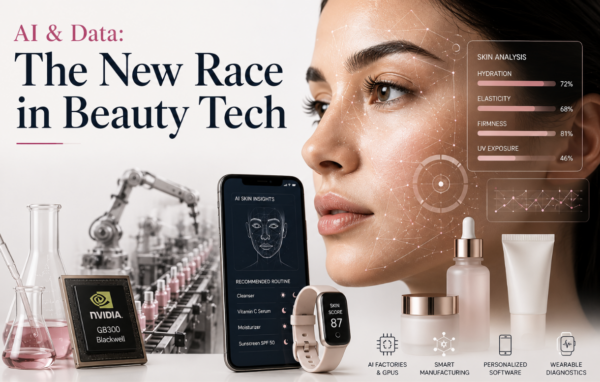
AI, Data, and the New Race to Define Beauty Technology
Artificial intelligence has already changed how consumers discover skincare products, receive personalized recommendations, and interact with beauty brands online. Now, the industry is entering its next phase, where success may depend less on the AI itself and more on the infrastructure, data, and scientific expertise behind it.
From Nvidia’s growing role in supplying the computing power behind AI models to wearable skin sensors capable of collecting real-world physiological data, beauty companies are investing across the entire innovation pipeline. AI is no longer limited to chatbots or virtual consultations. It is influencing product development, manufacturing, diagnostics, and long-term business strategy.
Computing Power Is Becoming Beauty’s New Infrastructure
Modern AI systems require enormous computing capacity. At the center of that infrastructure are graphics processing units (GPUs), specialized computer chips capable of processing massive datasets quickly enough to train and operate large AI models.
As industries compete for AI resources, governments have begun treating GPU access as strategic infrastructure. South Korea recently announced plans to expand its AI capabilities after Nvidia committed early access to its next-generation Blackwell GB300 GPUs and Vera Rubin chips. Together with the South Korean government and several leading cosmetics companies, the initiative aims to build large-scale AI factories supported by as many as 260,000 GPUs.
Although this level of computing is often associated with technology companies, beauty brands increasingly rely on the same infrastructure. AI models require significant processing power to analyze formulation research, evaluate biological datasets, identify product opportunities, and deliver increasingly personalized skincare recommendations.
Personalization Is Becoming a Business Strategy
AI is rapidly becoming integrated throughout the cosmetics value chain. Beyond recommending skincare routines, companies are using artificial intelligence to guide research priorities, identify portfolio gaps, forecast consumer demand, and accelerate product development.
According to Nvidia, combining advanced computing with decades of biological and formulation research allows companies to translate years of scientific work into personalized product recommendations delivered almost instantly.
However, access to powerful hardware alone is unlikely to determine which companies succeed.
Industry experts increasingly argue that the true competitive advantage lies in combining AI with clinically validated datasets, dermatology expertise, explainable algorithms, and real-world performance. Larger models running on faster hardware cannot compensate for poor-quality data. Instead, scientifically relevant information remains the foundation for meaningful personalization.
AI Is Transforming Cosmetic Manufacturing
Artificial intelligence is also reshaping how cosmetics are designed and produced.
South Korea’s investment in AI factories is expected to support manufacturing facilities capable of identifying production problems, making independent adjustments, and maintaining consistent product quality with minimal human oversight.
One example is Cosmax, one of the world’s largest original design manufacturers (ODMs) for cosmetics. The company has integrated AI throughout development, assembly, and packaging at its Pyeongtaek 2 manufacturing facility in South Korea.
According to the company, the facility is capable of producing 10.2 cosmetic units every second. AI-assisted color matching has reportedly reduced portions of the development process from five steps to three, while research and development simulations have expanded dramatically, allowing scientists to evaluate significantly more formulation possibilities during development.
Unlike traditional large-scale production facilities, Cosmax’s manufacturing model emphasizes flexibility. Smaller production runs allow brands to respond more rapidly to changing consumer preferences while shortening the time required to bring new products to market.
Kolmar Korea is pursuing a similar strategy through AI-assisted product planning. The company’s recently introduced platform enables users to create complete cosmetic concepts, from packaging selection to color ranges, in approximately 30 seconds. By analyzing accumulated research and development data together with current market trends, the system recommends optimized formulations that better match projected consumer demand.
Together, AI-assisted product planning and increasingly flexible manufacturing systems are creating a faster innovation cycle throughout the beauty industry.
Data May Become the Industry’s Greatest Competitive Advantage
As access to AI models becomes more widespread, differentiation may depend less on the technology itself and more on the proprietary data companies use to train it.
Rather than relying exclusively on general-purpose AI models, companies are increasingly refining open-source systems using decades of internal formulation research, consumer insights, and proprietary product information. This approach allows brands to build highly specialized models while maintaining ownership of the intellectual property created through their research.
One prominent example is L’Oréal Beauty Genius, developed in collaboration with Nvidia. The AI-powered beauty advisor combines computer vision with more than 100 years of proprietary skincare research to analyze users’ skin and recommend products from L’Oréal’s portfolio of more than 750 products.
The platform can answer questions about multiple beauty categories, evaluate visible skin concerns, recommend skincare routines, and suggest products tailored to individual users.
Other companies are taking similar approaches. Haut.AI recently introduced SkinChat, an AI platform that allows beauty brands to integrate AI-powered conversations directly into their own websites and social media platforms.
Beyond helping consumers choose products based on skin concerns, ingredients, or price preferences, these interactions generate valuable first-party data. Repeated consumer requests can reveal gaps within a company’s existing product portfolio, helping guide both future product development and broader marketing decisions.
As consumers increasingly expect evidence-based personalization rather than generic recommendations, AI systems are evolving into tools that inform both customer experiences and long-term business strategy.
AI Is Expanding Beyond Software Into Physical Devices
Artificial intelligence is no longer confined to digital platforms. Companies are increasingly embedding AI directly into wearable diagnostic technologies capable of monitoring skin continuously throughout daily life.
Earlier this year, Amorepacific introduced Skinsight, an electronic skin monitoring platform that received recognition as a CES 2026 Innovation Award Honoree. Developed in collaboration with researchers at the Massachusetts Institute of Technology (MIT), the platform combines an ultra-thin wearable sensor, Bluetooth connectivity, and an AI-powered mobile application.
The wearable continuously measures skin firmness, temperature, hydration, and ultraviolet light exposure over a 24-hour period. AI then analyzes these measurements to identify individual aging patterns, predict wrinkle development, and recommend personalized skincare routines and products.
According to the company, the technology has already contributed to product development efforts for its luxury skincare brand, Sulwhasoo, demonstrating how wearable diagnostics can inform both consumer recommendations and future formulation research.
These devices represent an important shift for the beauty industry. Rather than relying solely on occasional user surveys or subjective assessments, companies are beginning to collect continuous real-world physiological data that may provide a more objective understanding of how skin changes over time.
Looking Ahead
Artificial intelligence is rapidly becoming embedded throughout every stage of the beauty ecosystem—from laboratory research and product formulation to manufacturing, consumer education, and wearable diagnostics.
At the same time, the industry’s focus is shifting beyond simply building larger AI models. Increasingly, companies recognize that long-term success depends on combining powerful computing infrastructure with high-quality scientific data, rigorous clinical validation, and deep dermatologic expertise.
As AI continues to mature, the companies most likely to lead the next generation of beauty innovation may not be those with the fastest algorithms alone, but those capable of translating decades of scientific research into trustworthy, personalized, and clinically meaningful consumer experiences.