

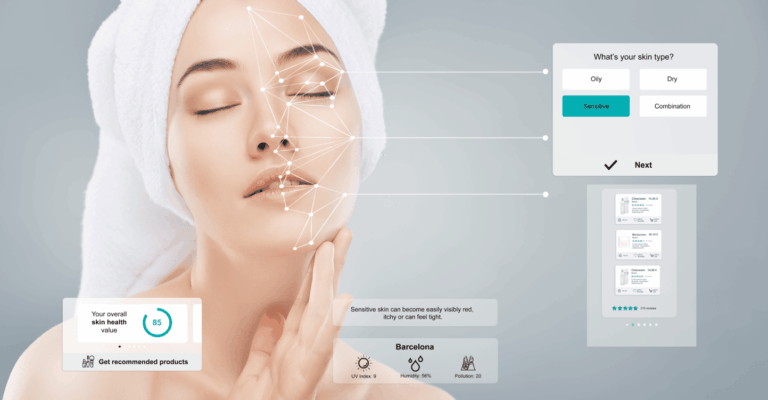
How Personalized Beauty Infrastructure Is Moving Beyond Mass-Market Skincare
For more than 30 years, the beauty industry has pursued personalization as a solution to product commoditization. Each decade introduced new approaches, from improved questionnaires and advanced algorithms to machine learning models trained on consumer data. While these innovations improved personalization, they shared a common limitation: they relied heavily on self-reported information and behavioral data.
In 2026, that model is beginning to change. Biological data is becoming the foundation of personalized beauty infrastructure. Skin wearables, microbiome testing, genomic skin profiling, and real-time diagnostic sensors are creating new ways for brands to understand individual biology rather than relying on demographic assumptions.
This shift represents more than another step forward in personalization. It marks a platform-level transformation that is reshaping beauty technology across multiple categories.
The Personalized Beauty Infrastructure Stack
The future of personalized beauty infrastructure consists of five core layers. Each layer follows its own technology development path and presents unique investment opportunities.
Layer 1: Real-Time Skin Sensing
Real-time skin sensing forms the foundation of personalized beauty infrastructure. Technologies such as the Amorepacific-MIT chipless wireless sensor platform, L’Oréal’s UV-monitoring patches, and emerging wearable skin sensors from startups and consumer electronics companies are building the next generation of data collection tools.
These technologies can measure commercially relevant skin parameters, including hydration, transepidermal water loss (TEWL), sebum production, skin pH, UV exposure, skin temperature, and potentially microbiome-related volatile organic compounds.
While the hardware is approaching consumer-ready form factors, the supporting data infrastructure and formulation response systems still require significant development.
Layer 2: Microbiome Characterization
Skin microbiome analysis provides one of the highest-resolution biological datasets currently available for skincare personalization.
Companies such as CAIOME use skin swab samples and technologies like 16S rRNA sequencing and shotgun metagenomics to analyze microbial activity and generate personalized recommendations.
Although researchers continue to improve the connection between microbiome signatures and skin health outcomes, the field is advancing rapidly. As datasets expand, microbiome-driven personalization is likely to become increasingly valuable.
Layer 3: Genomic and Epigenomic Skin Profiling
Consumer genomics has introduced another layer of personalized beauty infrastructure.
Companies including SkinShift and Geneu analyze genetic variants associated with collagen production, antioxidant activity, UV response, and inflammation sensitivity. These insights help place consumers into more targeted formulation recommendation groups.
While genomic skincare still faces clinical validation challenges, the underlying technology infrastructure is already established. Direct-to-consumer DNA collection, genotyping platforms, and algorithm-driven recommendations have proven commercially viable.
The most advanced personalization models will likely combine genomic insights with real-time biological data from sensors and diagnostics.
Layer 4: AI and Recommendation Engines
Data alone does not create value. AI systems transform biological information into actionable skincare recommendations.
This layer represents one of the most competitive areas within personalized beauty infrastructure. Companies that build proprietary datasets from long-term consumer cohorts gain significant competitive advantages because those datasets improve recommendation accuracy over time.
The L’Oréal-Nvidia predictive formulation partnership remains one of the most visible examples of large-scale investment in AI-driven beauty infrastructure.
Layer 5: Formulation Response
Personalized biological data only creates commercial value when brands can respond with personalized formulations.
Brands need either highly flexible product portfolios or manufacturing systems capable of producing individualized products. Companies such as Prose and Function of Beauty have demonstrated this model in adjacent categories, and similar approaches are emerging in skincare.
Today, formulation flexibility remains one of the weakest areas across the industry. As a result, investments in agile manufacturing and adaptive formulation capabilities may become some of the most important drivers of future growth.
The Investment Opportunity in Personalized Beauty Infrastructure
For investors and strategic acquirers, the strongest opportunities in personalized beauty infrastructure remain concentrated in several key areas.
These include companies developing skin-sensing hardware with defensible intellectual property, AI platforms supported by longitudinal consumer datasets, and businesses capable of generating clinically validated biological insights.
Beauty brands that actively build or acquire biological data infrastructure may be particularly well positioned as personalized beauty continues to evolve.
The $50 billion market estimate referenced in this article does not represent the industry’s current size. Instead, it reflects the projected addressable market for personalized beauty by the mid-2030s. That forecast is based on expected adoption rates for diagnostics, wearables, and biologically driven personalization platforms.
Companies that build personalized beauty infrastructure today are likely to capture a disproportionate share of future value creation.
The Dermatologist’s Role in Personalized Beauty Infrastructure
As personalized beauty infrastructure expands, dermatologists will play an increasingly important role in validating new technologies.
Board-certified dermatologists with expertise in both clinical medicine and technology provide a critical layer of scientific credibility. Their involvement helps distinguish medically grounded personalization platforms from consumer wellness products that lack meaningful evidence.
Companies that engage dermatologists as scientific collaborators rather than marketing partners will likely develop stronger validation data, greater consumer trust, and more defensible long-term businesses.