
L’Oréal and OpenAI Bring Beauty AI to ChatGPT
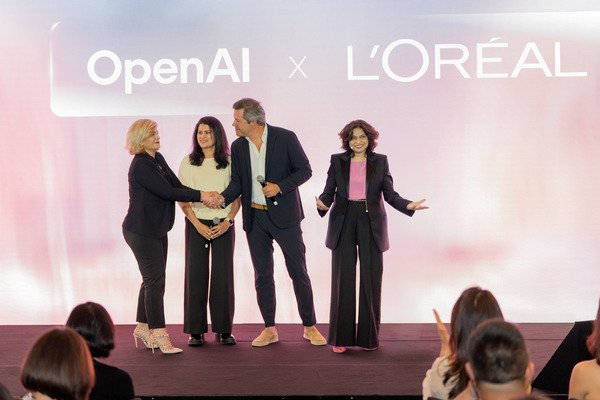
L’Oréal has announced a new partnership with OpenAI, marking one of the beauty industry’s most ambitious artificial intelligence initiatives to date. The collaboration, unveiled at VivaTech 2026 in Paris, spans consumer experiences, scientific research, marketing, and internal business operations. Together, the two companies aim to integrate AI more deeply across the beauty value chain.
While many beauty companies have experimented with AI tools, this partnership stands out because of its scale. It combines OpenAI’s rapidly advancing AI capabilities with L’Oréal’s extensive portfolio of beauty brands, research infrastructure, and consumer reach.
Bringing Beauty Commerce Into ChatGPT
The most visible component of the partnership is the integration of L’Oréal’s beauty portfolio into ChatGPT-powered consumer experiences.
Using L’Oréal’s ModiFace augmented reality technology, consumers will be able to virtually try on makeup products from brands such as Maybelline New York directly within conversational AI experiences. Rather than browsing through traditional product pages, users can discover products, ask questions, receive recommendations, and visualize different looks through natural language interactions.
The initiative reflects a broader shift in digital commerce. Product discovery is increasingly moving from search bars and retailer websites toward conversational interfaces that guide purchasing decisions in real time.
For L’Oréal, this creates a new channel for reaching consumers at the exact moment they are seeking beauty advice or product recommendations.
AI-Powered Product Discovery
Beyond virtual try-ons, the partnership aims to improve how consumers discover products across L’Oréal’s portfolio.
Brands including Lancôme and Kérastase are expected to leverage AI-powered recommendation systems that help match consumers with products based on their needs, preferences, and beauty concerns. The goal is to create a more personalized shopping experience while reducing friction between product discovery and purchase.
This development aligns with a broader trend across beauty technology. As AI models become increasingly capable of understanding consumer intent, recommendation engines are evolving from simple filtering tools into personalized beauty advisors.
The companies are also participating in OpenAI’s emerging advertising initiatives, creating new opportunities for beauty brands to connect with consumers during moments of active product consideration.
Expanding AI Into Scientific Research
While consumer-facing applications are likely to receive the most attention, the research component of the partnership may ultimately prove more transformative.
L’Oréal plans to use OpenAI’s GPT-Rosalind, a reasoning model focused on life sciences, to expand its microbiome research efforts. The company believes AI can help identify beneficial microorganisms, accelerate biological discovery, and support the development of future skincare innovations.
Microbiome science has become one of the most active areas of beauty and dermatology research. However, the complexity of microbial ecosystems creates enormous analytical challenges. AI systems capable of processing large biological datasets may help researchers identify patterns and relationships that would be difficult to uncover through traditional approaches.
For brands such as La Roche-Posay, the ability to accelerate microbiome research could influence future product development strategies and create new opportunities for biologically informed skincare.
Generative AI and Content Creation at Scale
The partnership also extends into marketing and creative operations.
OpenAI’s models will be integrated into CreAItech, L’Oréal’s internal generative AI content platform. The system is designed to help teams create images, videos, and marketing assets while maintaining brand consistency across global markets.
This reflects a growing challenge for large beauty companies. As content demands increase across social media, e-commerce, and digital advertising channels, brands need ways to produce high volumes of creative assets without sacrificing quality or brand identity.
Generative AI offers a potential solution by allowing teams to scale production while preserving visual standards and messaging guidelines.
AI as Enterprise Infrastructure
Perhaps the most important takeaway from the L’Oréal-OpenAI partnership is that AI is no longer being treated as a standalone technology initiative.
According to L’Oréal, more than 73,000 employees have already received training in generative AI, and internal systems such as L’OréalGPT are being deployed across the organization. The company’s latest announcement suggests that AI is becoming embedded across research, marketing, commerce, and operational workflows simultaneously.
This mirrors a broader shift occurring across the beauty industry. Companies are increasingly moving beyond isolated AI projects and toward enterprise-wide AI infrastructure strategies.
The Bigger Picture
The L’Oréal-OpenAI partnership illustrates how beauty companies are beginning to view artificial intelligence as a foundational business capability rather than a consumer-facing feature.
Virtual try-ons, conversational commerce, microbiome research, and generative content creation may appear to be separate initiatives. In reality, they represent different layers of the same strategy: using AI to strengthen consumer engagement, accelerate scientific discovery, and improve operational efficiency.
As beauty brands continue investing in personalization, biological research, and digital commerce, partnerships between technology companies and beauty leaders are likely to become increasingly common.
For now, the L’Oréal-OpenAI collaboration offers one of the clearest examples of what an AI-native beauty company may look like in the years ahead.
Source: https://wwd.com/beauty-industry-news/beauty-features/loreal-partners-openai-vivatech-1239013466/