

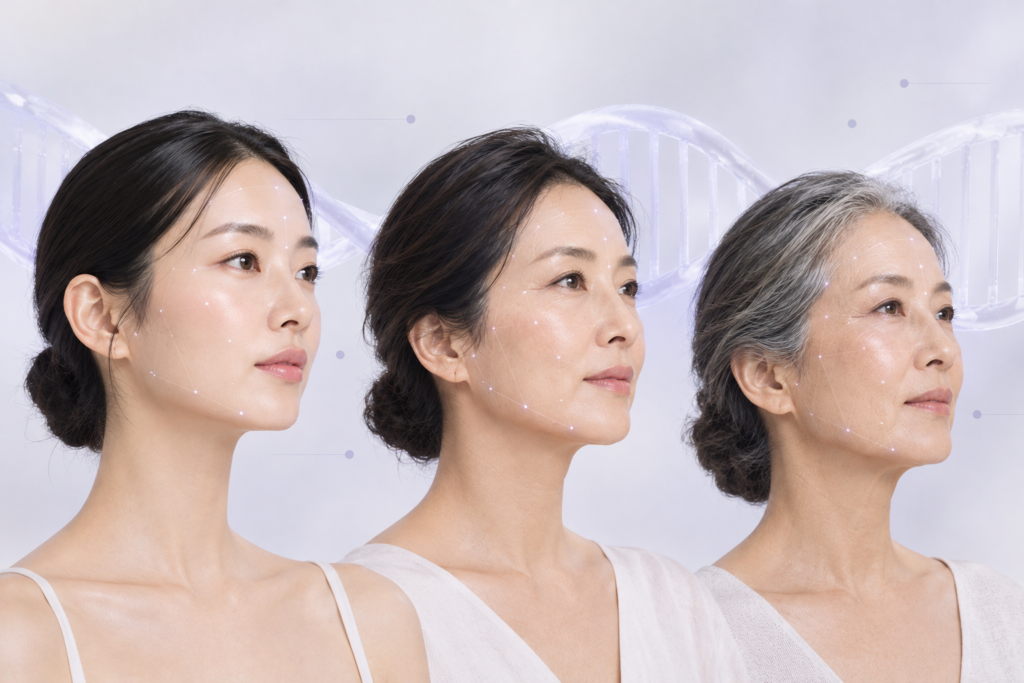
Does your whole face age at the same pace? According to new research from Korean beauty giant LG Household & Health Care (LG H&H), it does not. Using visual AI to analyze facial images from 16,000 Korean women, the company found that the eyes, lips, and facial contours each follow their own aging timeline.
The study, published in the Journal of Investigative Dermatology, also identified 10 genetic markers linked to facial aging. LG H&H describes it as the largest study of its kind in Korean subjects and a cornerstone of its Skin Longevity project, which aims to build skincare personalized by both age and genetics.
How the AI Works
The approach is more grounded than the phrase “visual AI” might suggest. Researchers used Python with widely available open-source image tools, dlib and OpenCV, to automatically locate 68 facial landmarks on high-resolution photos of women aged 20 to 60.
Tracking how the distances and ratios between those points change with age let the team quantify six signs of aging:
- Eye tail sagging
- Eye width ratio
- Philtrum height ratio (the groove above the upper lip)
- Lip ratio
- Facial width ratio
- Facial contour degree ratio
This is a shift from how skin aging is usually measured. Most cosmetic testing focuses on wrinkles, tone, or pigmentation in small patches of skin. LG H&H is instead measuring changes in facial shape across the whole face, which is closer to what people actually notice in the mirror.
Different Regions, Different Clocks
The central finding is that each part of the face has its own aging clock:
- The eye area shows accelerated sagging before age 50.
- The lips and surrounding skin change significantly after 50.
- Facial contours change steadily across all age groups.
LG H&H suggests skincare priorities could shift with age accordingly, emphasizing the eye area in the 30s and 40s and the mouth area after 50.
The Genetic Layer
The team also ran a genome-wide association study (GWAS) and identified 10 genetic markers tied to facial aging, many related to skin tissue development and elasticity. Two examples: FOXL2, a gene involved in eyelid development, where certain variants were associated with faster eye-area aging, and FGF10, which is involved in collagen production and overall facial structure.
The company says these markers could eventually allow skincare tailored to a person’s inherent genetic tendencies, not just their age.
What the Science Supports, and What It Doesn’t Yet
This is a real, peer-reviewed study with a large sample, and that sets it apart from much of the AI marketing in beauty. Still, a few distinctions matter:
- Description is not treatment. The study maps how faces change. It does not show that any product slows those changes. Many of the measured features, such as sagging and contour, reflect fat, bone, and ligament changes that topical skincare has limited ability to reach.
- Genetic associations are not personalization yet. A GWAS finds statistical links across a population. Turning a single person’s genetic variants into a meaningfully different, more effective product is a much larger leap that has not been demonstrated.
- Age patterns need careful reading. The article does not say whether the same women were followed over time. If the data compare different women at different ages, the timelines reflect group differences rather than how any one face ages.
- One population, one sex. All participants were Korean women.
Representation Cuts Both Ways
That last point deserves its own mention. Large datasets in dermatology AI have historically skewed toward lighter-skinned, Western populations, so a study of this scale in Korean women helps fill a real gap.
But the findings cannot be assumed to apply elsewhere. Facial structure, fat distribution, and aging patterns differ across ancestries and between sexes, and the genetic variants identified may occur at different frequencies in other groups. Any diagnostic platform built on this data would need validation in diverse populations before being marketed to them.
The Bigger Picture
LG H&H plans to use these findings in its visual AI skin diagnostic platform, showing customers how their facial aging patterns change by region in real time. That fits a broader industry move toward skin longevity and AI-driven diagnosis as a gateway to personalized products.
The research itself is a useful contribution to understanding facial aging. The open question is whether the products that follow will be held to the same evidentiary standard as the study, or whether “genetically personalized” becomes the next label applied faster than the data can support it.