

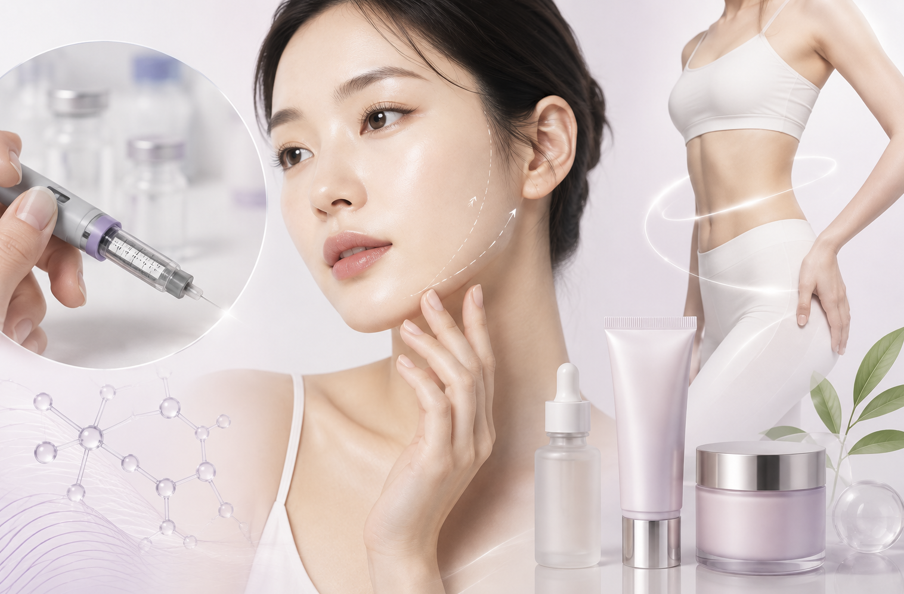
A New Approach to Skin Structure and Facial Volume
South Korea’s beauty industry continues to push aesthetic innovation, with new treatments targeting facial volume loss and changes in skin structure following significant weight loss. A new generation of skin boosters is moving beyond traditional collagen-stimulating ingredients and exploring extracellular matrix (ECM) derived from donated human skin tissue.
The trend comes as demand for aesthetic treatments grows alongside the popularity of GLP-1 medications and other weight-loss approaches. Significant or rapid weight loss can reduce facial volume and increase the appearance of skin laxity, a change often described as “Ozempic face.”
From Skin Boosters to Skin Regeneration
Traditional skin boosters, including polynucleotides and other collagen-stimulating treatments, encourage the skin’s own regenerative processes. The newer approach takes a different path by introducing an acellular extracellular matrix designed to provide structural support within the skin.
One example highlighted in the article is Re2O, a Korean skin booster made from processed donated human skin tissue. Manufacturers remove the cellular components before use, leaving an extracellular matrix that provides a structural framework within the treated tissue. Over time, the patient’s own cells can repopulate this framework.
This approach represents a notable shift in aesthetic medicine. Instead of simply stimulating the skin to produce more collagen, researchers and clinicians are exploring whether rebuilding the tissue environment itself could improve skin quality and volume.
Why “Ozempic Face” Is Driving Interest
The growing use of GLP-1 medications has created a new challenge for aesthetic medicine. Significant or rapid weight loss can reduce facial soft-tissue volume, making some areas of the face appear more hollow or lax.
However, GLP-1 medications do not exclusively cause these changes. Any significant weight loss can affect facial volume, depending on the individual. The term “Ozempic face” has simply become a popular way to describe these changes.
This shift has increased interest in treatments that focus not only on restoring volume but also on improving skin quality and structure. The expanding K-beauty skin-booster market reflects a broader move toward regenerative and tissue-focused aesthetics.
The Growth of Regenerative Aesthetics in Korea
South Korea has established itself as a major hub for aesthetic medicine, with clinics increasingly offering injectable and regenerative treatments. Medical tourism has also fueled demand as international visitors travel to Seoul to explore newer aesthetic technologies and procedures.
Consumer preferences are changing alongside this growth. Rather than simply adding volume or dramatically altering facial features, many patients now seek treatments that improve skin quality, firmness, and overall facial appearance while preserving a natural look.
Innovation Comes With Important Questions
Using donated human tissue in cosmetic procedures also raises important ethical and regulatory questions. Re2O uses donated tissue that undergoes processing to remove cells and follows tissue standards designed to address donor authorization and safety. However, the category has sparked debate in South Korea over whether companies should use donated human tissue for cosmetic purposes rather than traditional medical applications.
These questions highlight the need to evaluate aesthetic innovation beyond its potential benefits. Clinical evidence, safety, sourcing, regulation, and long-term outcomes all matter when new technologies enter the market.
The Future of K-Beauty
K-beauty has long built its reputation on innovative skincare ingredients and multi-step routines. Its next evolution could increasingly connect regenerative medicine with aesthetic dermatology.
The emergence of human tissue-derived skin boosters shows how quickly skincare, biotechnology, and medical aesthetics are converging. As these technologies develop, the industry may shift its focus from simply adding volume toward supporting the skin’s underlying structure.
For patients experiencing facial changes after significant weight loss, no single “Ozempic face” treatment works for everyone. The right approach depends on whether the primary concern involves volume loss, skin laxity, changes in skin quality, or a combination of factors.
The most important trend to watch may therefore involve more than any single treatment. The industry continues to move toward personalized, regenerative approaches to aesthetic medicine, potentially reshaping how clinicians approach facial changes after significant weight loss.
K-beauty wants to fix the ‘Ozempic face’ problem – The Japan Times