

How Skin Wearable Technology Enables Personalized Skincare
The beauty industry has pursued true personalization for decades. The goal has always been to tailor skincare to an individual’s biology rather than a broad marketing category. More recently, questionnaire-based personalization tools, AI skin analysis from selfies, and skin typing assessments have moved the field forward.
However, these approaches share a major limitation. They capture a single moment in time rather than a person’s continuously changing skin condition.
Skin behavior is highly dynamic. Hydration levels fluctuate with humidity, diet, and hormonal cycles. Sebum production changes throughout the day and across seasons. Skin pH responds to product use, while barrier function shifts with UV exposure and temperature.
As a result, a skincare recommendation based on a questionnaire or photograph captures a snapshot rather than the full picture. What the industry has long needed is continuous, real-time monitoring of skin physiology. Today, skin wearable technology is bringing that possibility closer to reality.
The Amorepacific-MIT Skin Wearable Technology Platform
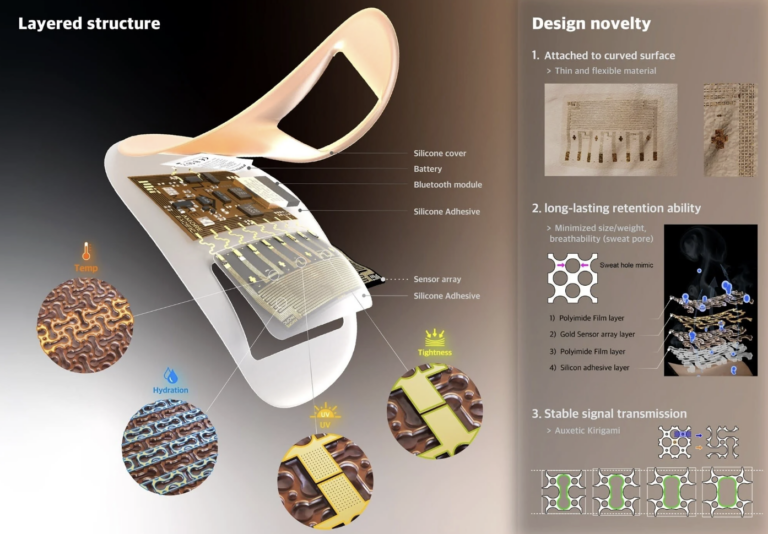
The partnership between Amorepacific, Korea’s largest beauty company, and MIT’s Research Laboratory of Electronics has produced a chipless wireless skin-sensing platform. Developed with Professor Fadel Adib’s Signal Kinetics Group at MIT, the device represents an important step toward continuous skin monitoring.
The platform uses RF backscatter technology to transmit sensor data wirelessly. Unlike many wearable devices, it does not require an onboard chip or battery.
This design offers several practical advantages. First, it eliminates the battery replacement challenges that have limited adoption of many wearable health sensors. Second, it reduces both device size and manufacturing costs. Finally, it enables thin, flexible sensors that can conform to the skin, function as wearable patches, or potentially integrate into cosmetic formats.
The researchers demonstrated the platform’s ability to measure hydration, transepidermal water loss, pH, and skin temperature. These physiological markers play an important role in skincare personalization.
From an industry perspective, this development is more than a technology demonstration. Amorepacific already has the distribution network, formulation expertise, and consumer relationships needed to deploy a connected skin monitoring platform at scale.
The MIT collaboration provides the core sensor architecture. However, several pieces still need development. These include the consumer software layer, formulation recommendation systems, and the privacy and regulatory frameworks required for large-scale adoption. While these challenges are significant, they are also addressable.
The Competitive Landscape for Skin Wearable Technology
The Amorepacific-MIT platform enters an increasingly competitive market.
L’Oréal’s My Skin Track UV sensor, an NFC-enabled UV monitoring patch launched in 2019, represents an earlier version of the same concept. Rather than measuring skin physiology directly, the device focused on tracking UV exposure. Because L’Oréal distributed the product through Apple channels, it also demonstrated that consumers are willing to engage with skin wearable technology when the user experience is convenient.
Meanwhile, major consumer electronics companies are entering the space. Samsung and Qualcomm have both filed patents related to continuous skin health monitoring through smartwatch and smart ring platforms.
This trend highlights a potential challenge for beauty companies. Consumer electronics brands already have large wearable user bases and established device ecosystems. As a result, they may be well positioned to compete in skin monitoring.
Startups are also contributing to innovation in this area. Epicore Biosystems is developing microfluidic sweat analysis technology. Halo Labs focuses on continuous transepidermal water loss monitoring. In addition, several stealth-mode companies emerging from academic biophysics laboratories are developing new approaches to skin sensing.
Although the category remains early-stage, investment activity and commercial interest continue to accelerate.
Why Data Infrastructure Matters for Skin Wearable Technology
The most overlooked challenge in building a successful skin wearable platform is not the sensor itself. Instead, it is the underlying data infrastructure.
A continuous skin sensor generates large volumes of physiological data. Companies must capture, store, process, and analyze this information before translating it into useful product recommendations.
This process requires several components. First, companies need a secure data pipeline that connects devices to cloud infrastructure. Second, they need machine learning models capable of translating physiological measurements into skincare recommendations. Third, they need formulation libraries flexible enough to adapt to changing skin conditions. Finally, they need consumer-friendly interfaces that make complex physiological information easy to understand.
Consequently, the beauty companies most likely to succeed are those investing in both AI infrastructure and sensor development simultaneously.
Regulatory Challenges for Skin Wearable Technology
Skin wearable technology exists in a complex regulatory environment.
For example, a device that measures skin hydration to improve cosmetic recommendations falls into a different category than a device that monitors hydration as part of atopic dermatitis management. The first functions primarily as a consumer wellness tool. The second may require FDA oversight.
As sensor capabilities become more sophisticated, the distinction between wellness and medical devices will become increasingly important.
Dermatologists will play a critical role as the category evolves. Clinicians with expertise in both medicine and technology can help validate new platforms, guide clinical research, and support responsible deployment.
Ultimately, companies that engage healthcare professionals early, generate strong clinical evidence, and address regulatory questions proactively will have a significant advantage. Those that ignore these considerations may struggle as skin wearable technology moves closer to healthcare applications.