
The AI Dermatology Market in 2026: More Signal, Still Noise
The dermatology AI landscape looks very different in 2026 than it did between 2018 and 2020. During that period, many computer vision startups claimed they could diagnose melanoma from a smartphone photo as accurately as a dermatologist.
Since then, real-world deployment, clinical scrutiny, and regulatory review have reshaped the field. While the distinction is not always clear, some tools now demonstrate genuine clinical value. Others still function primarily as consumer wellness products rather than clinical solutions.
This article evaluates the 2026 AI dermatology landscape across four categories: diagnostic imaging, ambient documentation and clinical AI, consumer-facing skin analysis, and AI-assisted formulation and product development. Ultimately, the goal is to help clinicians, investors, and industry partners identify where meaningful value exists.
Category 1: Diagnostic Imaging AI
Where the Evidence Is Strongest
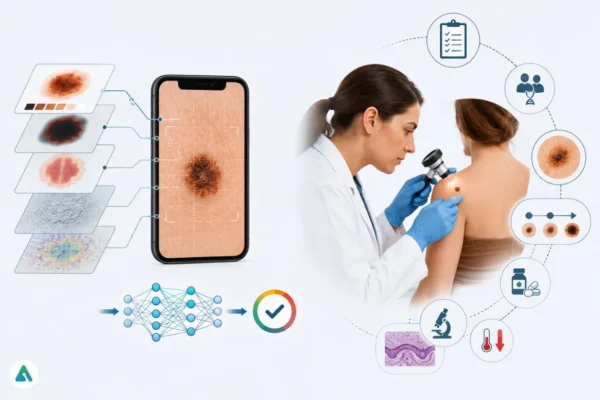
Diagnostic imaging remains the most clinically validated application of AI in dermatology. Deep learning models trained on large dermoscopic image datasets have achieved performance levels comparable to expert dermatologists in controlled melanoma detection studies.
Currently, the ISIC (International Skin Imaging Collaboration) database provides the most credible benchmark for lesion analysis AI. Researchers have used this dataset extensively in academic validation studies. Several companies operate in this space. Skintelligence integrates AI with existing clinical dermoscopy hardware. Meanwhile, DermAI platforms focus on teledermatology triage. Other companies, including 3Derm and Skin Analytics, have successfully navigated the FDA 510(k) clearance pathway.
Importantly, FDA-cleared medical devices differ significantly from consumer-facing applications. As a result, regulatory status should play a major role in deployment decisions.
The Persistent Performance Gap
Despite strong study results, an important limitation remains. Most published performance metrics come from highly controlled research settings. For example, researchers typically use high-quality images, standardized lighting, and dermoscope-captured photographs of known lesion types. However, real-world conditions are far less predictable.
Patients often submit smartphone photos with inconsistent lighting, variable image quality, and diverse lesion presentations. Additionally, performance can vary across skin tones. As a result, most AI systems perform worse outside controlled environments. Several independent validation studies have documented this gap.
For now, the most realistic role for dermoscopy AI is triage support. In teledermatology settings, these tools can help prioritize high-risk submissions. However, they should not replace review by a trained dermatologist.
Category 2: Ambient Scribing and Clinical Workflow AI
The Most Underrated Clinical AI Application
Among all AI applications in dermatology, ambient scribing may offer the strongest combination of proven value and relatively limited hype. These tools use natural language processing and ambient audio capture to generate clinical notes automatically. Published studies show reductions in physician documentation time ranging from 40% to 60%. As a result, physicians can either increase patient capacity or reduce administrative burden.
Suki AI is one of the more mature platforms in this category. Based on my own evaluation in clinical practice, the platform performs particularly well in several areas. First, it integrates with major EHR systems. Second, it offers flexible specialty-specific templates. Finally, it can handle dermatology-specific documentation, including lesion descriptions, procedural notes, and ABCDE assessments. Together, these features make it a strong option for dermatology practices considering adoption.
However, several challenges remain. EHR integration quality varies by system. Additionally, most physicians need an adjustment period before they realize meaningful efficiency gains. Other competitors include Nuance DAX, Nabla Copilot, and Ambience Healthcare. As the market matures, practices should focus on three evaluation criteria: EHR integration quality, dermatology-specific template support, and HIPAA compliance documentation.
Category 3: Consumer-Facing Skin Analysis
High Hype, Mixed Evidence
Consumer skin analysis remains the most crowded segment of the dermatology AI market. At the same time, it remains one of the least clinically validated. Many applications offer skincare recommendations, skin concern analysis, or skin health scoring based on smartphone selfies. However, transparency varies considerably between platforms.
The strongest consumer applications limit their claims to cosmetic skin assessment. For example, they may evaluate hydration appearance, skin texture, tone evenness, or visible pore size. Within those boundaries, smartphone-based skin analysis can provide useful insights. In contrast, medical diagnostic claims require a much higher standard of evidence.
Haut.AI offers a useful example of a more responsible approach. Its SPF Truth Booth and skin atlas initiatives focus primarily on education rather than diagnosis. Consequently, they represent a more appropriate use of generative AI in consumer skincare. Investors and brand partners should ask several important questions when evaluating consumer skin AI.
First, how diverse is the training dataset? Systems trained primarily on lighter skin tones often perform less accurately on darker skin tones. As a result, limited diversity can create meaningful clinical and safety concerns. Second, what is the platform’s regulatory status? Finally, what evidence supports the claims being made? These questions often reveal more about a platform’s value than marketing materials alone.
Category 4: AI in Formulation and Product Development
The Most Commercially Significant Near-Term Opportunity
Predictive formulation may ultimately become the most commercially important AI application in the broader beauty and dermatology ecosystem. The L’Oréal-Nvidia partnership illustrates this opportunity well. I have discussed this initiative extensively on BeautyTechDerm because it highlights where formulation science is heading.
AI systems can simulate ingredient interactions, predict formulation stability, and model consumer sensory outcomes. As a result, companies can reduce both development costs and R&D timelines. Although commercial deployment remains relatively early, the underlying technologies continue to advance rapidly.
These technologies include molecular simulation, generative AI for ingredient discovery, and machine learning applied to formulation databases. Consequently, brands and CROs that build computational formulation capabilities today may gain a significant competitive advantage over the next three to five years.
Another interesting area involves regulatory strategy. AI may eventually help predict bioavailability, penetration, and formulation stability. Furthermore, these capabilities could accelerate safety data generation for new active ingredients. As a result, AI could influence the development of next-generation UV filters, actives, and advanced delivery systems seeking FDA approval.
The Investment and Partnership Takeaway
For investors and brand partners, three areas stand out in 2026. First, ambient scribing offers proven value and remains underadopted. Second, dermoscopy triage continues to improve as regulatory pathways become clearer. Third, formulation AI represents an early-stage opportunity with substantial long-term strategic importance.
Consumer skin analysis remains a higher-risk category. Unless platforms demonstrate strong clinical validation and diverse training datasets, investors should approach claims cautiously.
Finally, dermatologists themselves have become an important competitive asset. They provide clinical validation, expert oversight, and KOL credibility. Consequently, companies that build strong dermatologist partnerships may gain a meaningful advantage as the AI dermatology market continues to evolve.